
Monday, 8 April 2013

Exponential Growth
My cloning cyborgs reminded me of bacteria and viruses, which linked me to a couple images for house reference:
 |
| Windows? |
 |
| Tower? |
Hexagons in Architecture


My favourite example is from Ma Yansong, founder of MAD, who I found in an past issue of Icon over the Summer.

Furniture for a Hive


 If the furniture mesh could construct furniture, why not just morph out from the walls, floors and ceilings?
Hexagons and Hives
To redesign my home I needed to really question the purpose of my cyborg and home.
Firstly, I went back to my cyborgs activity: cloning. If there are going to be multiple clones, the home will need to accommodate masses, and have the ability to constantly grow.
The idea of many cells for a team/army of clones lead me to the inspiration of beehives and wasp nests as inspiration.


The hexagonal cells provide a more architectural shape to help define the home, but have the ability of creating curved structures like I had been look at. The insect drones are a great reflection of my cyborg clones. It also inspired me to think of a greater purpose for my cyborgs. If they are living in a ruined city, what are they doing there, and why bother cloning themselves?
The cyborgs could use the rubble of the city, in a similar way to wasps use wood to build nests. The cyborgs are send out from the home or 'nest' where they are cloned, to bring back rubble which is melted down in the home to form the fluid material which creates the cyborgs and their home.
This task has the second aim of clearing the city to allow the cyborgs to rebuild. The cyborgs have been formed from liquidated building materials and will morph into buildings like one did with the initial home base to recreate a city.

Sunday, 7 April 2013
City Ruins Setting
A drawing I used to explore my house in its setting.

First issue is that the design of the house is not relating and reacting to the ruins.
Second is the green. I considered my cyborg having chloroplasts in its skin so it could photosynthesize to gain energy. I looked at relating my house design to plant life, but decided it was not a direction I wanted to take.

First issue is that the design of the house is not relating and reacting to the ruins.
Second is the green. I considered my cyborg having chloroplasts in its skin so it could photosynthesize to gain energy. I looked at relating my house design to plant life, but decided it was not a direction I wanted to take.
Wednesday, 3 April 2013
Home Sweet Cyborg

This wire frame may look like I've created a home for a tunnel spider, but it is in fact a home morphed out of my own cyborgs body.
While I was impressed with some of my fellow students abilities in ArchiCAD to make nice human homes, I felt the stock tables and chairs weren't suitable for an elastic cyborg living post nuclear war. (Perhaps radiation has something to say for his consistency?)
Instead, my cyborg creates his home by stretching it out of his own body! This is my first exploratory model:
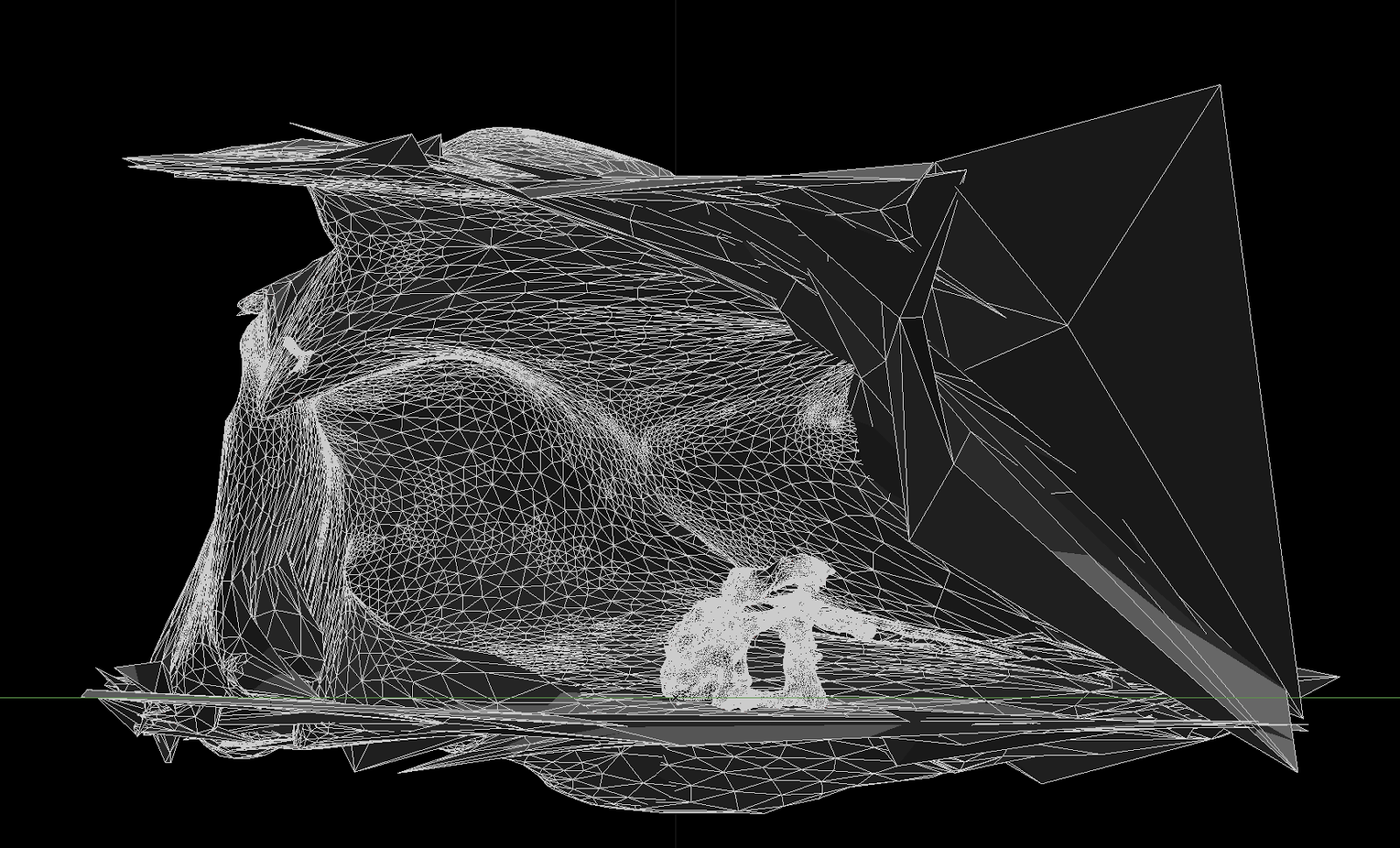


In the last elevation you can see the form of an arm that wasn't completely morphed into the building. While I initially joked the house could wave goodby to you as you leave for work, I'm now considering whether the home should retain a level of humanity and awareness.
It's an intriguing concept, how much we relate to our homes and connect with them on a personal level. Having lived in the same home for the majority of my life, I feel like it's a true extension and representation of my family. I believe simple rituals like eating dinner at our small kitchen table every night have a large effect on our family dynamic.
So I'm going to push the idea of our connection to our homes with my cyborg. Maybe the home retains the ability to communicate with my cyborg, to combat loneliness in an uninhabited city. Perhaps the house understands when my cyborg is sleeping, so that it can shrink down in size to hold heat overnight more effectively. Or do the walls literally have ears?
Subscribe to:
Posts (Atom)